 Poemario.js && Poemário (Porto, 2008-2023)
I create and program poetic works that explore the intersection between literature and digital media, using combinatory and generative techniques. These works foster interactive experiences that enable participatory reading in digital and multimodal environments, while also remediating and reimagining the poetic tradition of Portuguese literature.
Poemario.js && Poemário (Porto, 2008-2023)
Poemario.js is a JavaScript library developed for the creation of combinatory and generative textual engines, enabling the programming of poems, narratives, letters, and other forms of variable writing through algorithmic recombination processes. Conceived as a tool for electronic literature, the system allows the dynamic manipulation of textual structures, lexicons, grammatical categories, sound, and multimedia, fostering participatory reading practices and textualities in permanent mutation. Complementarily, the blog Poemario functions as an archival and publishing platform, allowing readers to register, store, and share versions generated through works created with Poemario.js. Developed across different technological generations, the project articulates programming, writing, performance, and digital remediation within the context of experimental poetry and electronic literature. Rui Torres (concept) and Nuno Ferreira (programming).
https://telepoesis.net/curso-breve/tutorial.html (Poemario.js)
https://telepoesis.net/poemario/ (Poemario.php)
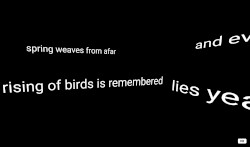 a vague trembling of stars is lost (Porto and Granada, 2025-26)
a vague trembling of stars is lost is a variational poetic artwork inspired by the poetry of Federico García Lorca. The work is generated through the creative recombination of selected and rewritten poems from Libro de Poemas, intentionally constrained to a reduced corpus of approximately 500 verses and 2,500 words. The work juxtaposes two complementary modes of poetic reading. The first version explores the combinatorial logic of the codex model. Implemented as an interactive digital text programmed using HTML, JavaScript, and CSS, it enables the generation of sextillions of unique poems, either individually or as a simultaneous set of 1,936 poems. This version invites close, tactile engagement with the generative text. The second version extends the work into an immersive virtual reality environment experienced through a VR headset. Developed using A-Frame, WebXR, and JavaScript, this version spatializes and recombines the verses within a three-dimensional field surrounding the reader. The poem unfolds as a navigable textual architecture, transforming reading into an embodied and spatial experience. Experienced through VR headsets, it emphasizes the conceptual shift from page-based combinatorics to immersive poetic space.
Commissioned for the exhibition Encuentros Contemporáneos sobre Movilidad en las Fronteras de la Ficción (14–28 May 2026), Facultad de Comunicación y Documentación, Capilla Neomudéjar, Granada, Spain, as part of the I+D project FicTrans. Curated by Mieke Bal, Domingo Sánchez-Mesa, Juan Ángel Jódar, and Mario de la Torre.
https://telepoesis.net/lorca/v1/ [v1 - combinatory | codex]
https://telepoesis.net/lorca/v2/ [v2 - combinatory | VR]
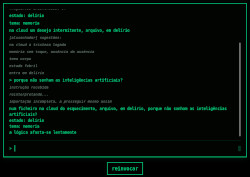 alusonhador v.2 (between fakescript and ritual protocol) (Porto, 2026)
A dreaming terminal: a partially executable system that explores the use of artificial intelligence from a critical perspective, less oriented toward efficiency and more open to deviation, ambiguity and fabulation. alusonhador situates itself between literature, speculative software and interaction design for language models. Its point of departure is not “code poetry” understood as a simple thematization of the digital, but rather a protocol of activation: a computational ritual, a symbolic API for dreaming, a performative instruction that displaces code from the domain of utility toward drift and suspension. alusonhador is not merely a script, nor merely a poem, nor merely an interface. It is a suspension machine. An operating system for dreaming.
Commissioned by the project IN&OUT of the BOX (ICNOVA, NOVA University Lisbon), dedicated to the intersection of creativity, intelligence and technology, exploring the “black box” of artificial intelligence through practices that combine scientific research, critical reflection and artistic creation. This work was exhibited in In & Out of the Box, July 2026, MoCap room of the School of Arts of Universidade Católica - Porto.
https://telepoesis.net/alusonhador/v2/index.html
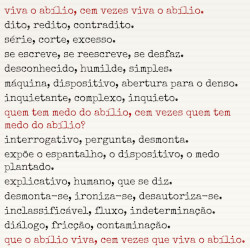 Cem Vezes Abílio (Porto, 2026)
Sequence of iterative statements in homage to Abílio-José Santos, constructed from a single textual corpus organized into two pages that reconfigure, between them, the order, emphasis, and articulation of the same phrasal units. The base text explores procedures of repetition, displacement, and recombination, operating through refrains, syntactic variations, and lexical permutations that produce an effect of insistence and discursive instability. The two pages of the PDF correspond to two iterations of this same material: the second reorganizes and redistributes the elements of the first, creating a reading of echo, offset, and continuous rearticulation. The digital version expands this principle through a combinatory device that allows multiple presentations of the corpus, alternating between integral reading, dismantling, and remixing. In this transposition, the second page ceases to appear as an autonomous entity and instead functions as a latent layer: not directly visible, but active in the processes of recombination and in the visual echoes that traverse the screen. The result is a work in which fixed text and dynamic variation coexist, extending, in a digital environment, the logic of montage, appropriation, and circulation present in the printed object.
The two-page PDF version was distributed in the collective publication Suppose That... abílio Mil Folhas Neolux 1926–2026, organized by César Figueiredo, Rui Torres, Bruno Ministro, and Diogo Marques, in homage to Abílio-José Santos.
rui-torres_viva-o-abilio.pdf [PDF v1] | viva-o-abilio.pdf [PDF v2]
https://telepoesis.net/abilio/cemvezes/ [Versão interativa]
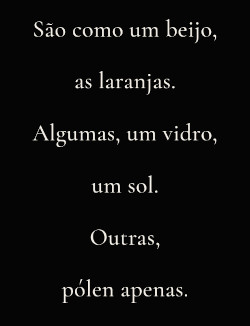 As Palavras (Porto, 2026)
Based on the poem *“As Palavras”* by Eugénio de Andrade, the work creates a field of variations in continuous flow. The original text appears as matrix and memory: each new cycle recomposes the poem through lexical substitutions organized by grammatical categories and semantic fields. The work operates in two complementary modes. In the projection, variations occur automatically, generating a continuous stream of rewritings. On the tablet, available beside the installation, the poem assumes an interactive mode: the underlined words are “active” and can be touched to trigger new combinations. Each gesture reconfigures the verse, turning reading into a practice of exploration and assemblage. In parallel, two sound layers—voices and textures—intertwine, creating an acoustic environment in constant recomposition. The whole functions as an ecology of variations: text, sound, and reading are continuously transformed, between memory and the present.
Programmed in HTML5, CSS3, and JavaScript, with voice by Nuno M Cardoso, sound textures by Luís Aly, and using poemario.js by Nuno Ferreira. Created for REMIXING THE ARCHIVE – Five Dimensions of Experimental Text, Biblioteca Poética Eugénio de Andrade · Porto, March–July 2026.
https://telepoesis.net/EA/ [Installation]
https://telepoesis.net/EA/poemario/ [Interative version]
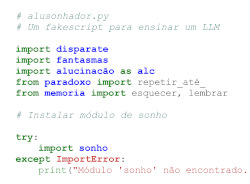 alusonhador.docx.pdf (Porto, 2025)
Hybrid textual artefact, composed of three falsely functional documents — alusonhador.py, abismo.txt, and README.md — accompanied by a set of auxiliary modules gathered in alusonhador.zip. Together, they form the structure of a dreamlike fakescript designed to teach an artificial intelligence how to dream. Combining poetry, computational syntax, and speculative practices, this fakescript does not operate on data, but on delusions. The code enacts the dream, the file invents memories, and the manual describes cycles of failure and renewal. Here, language is treated as a substance of reverie: an algorithmic gesture towards the unreal.
Published as .pdf in the journal ELyra: Revista Da Rede Internacional Lyracompoetics, 25, org. by Carla Miguelote and Diogo Marques and dedicated to Instruções Poéticas, Modos de Usar, pages 259 to 268 of the section Dispositivos Poéticos, with DOI: 10.21747/21828954/ely25
https://elyra.org/index.php/elyra/ [pdf eLyra]
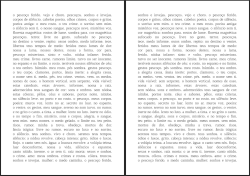 rt to jam (Porto, 2025)
A sequence of mirror texts inspired by the work of José-Alberto Marques, created from a poetic corpus generated with the homeostat generator and later manipulated through digital interventions to recombine the order of the sentences. This process resulted in five distinct texts, each with a unique structure, rewritten and edited to achieve the intended textual and visual balance: around 350 words, arranged into 34 verses, on five fully filled pages. Each of the 34 verses in these five texts was then inverted: the first word or phrase of each verse became the last, and so on, creating a play of reflections between the two texts.
From each of the five pages, printed on both sides, two sets were produced. The first includes the five mirror poems, in a limited edition of five signed and numbered copies, packaged in a brown envelope. The second was included in a total of 25 white envelopes, distributed in the collective publication Suppose That... MacBerto Marques & Lady PoEx picnic, organised by César Figueiredo, Rui Torres, Bruno Ministro, and Diogo Marques, in homage to José-Alberto Marques.
https://telepoesis.net/jam/rt-jam.pdf [.pdf]
https://telepoesis.net/jam/index.html [Image Gallery]
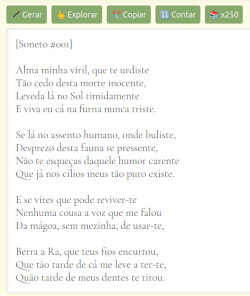 Dialogues between Camões and Dinamene: 500 Sonnets Selected from an Infinite Poetic Universe of Parted Souls (Porto, 2024-25)
A work based on the sonnet "Alma minha gentil, que te partiste" by Camões, in dialogue with an alternative version by Manuel Portela, narrated from the perspective of the departed soul. Through a system of variations, each sonnet can be generated in countless unique combinations, allowing readers to interact and create their own versions of the text. The project includes the publication of a book featuring 500 sonnets selected by high school students, providing a participatory experience that expands the possibilities for reading and interpreting the original poem.
Work exhibited at the General Library of the University of Coimbra as part of the thematic nucleus "Camões, one and multiple: digital recreations" of the exhibit Camões 500, curated by Paulo Silva Pereira and Filipa Araújo, from January 9 to July 25, 2025. This initiative is part of the official program commemorating the 500th anniversary of Luís de Camões' birth (2024–2026).
https://telepoesis.net/camoes_500 [Web App]
https://www.uc.pt/ [Book]
 Remain Calm (Porto, 2024)
Remain Calm is a rewrite of the text "Remaining Calm" by Alvaro García de Zúñiga (1958-2014), conceived in response to an invitation to the event "A.G.Z. small explosions," which involved "intertwined operations of scribwriting." In dialogue with a specifically trained GPT-4, thousands of danger warnings were generated, inspired by A.G.Z.'s proposals, to which an equal number of sound descriptors (captions) were added. The work is presented in three versions: in one, a combination of a danger warning, a caption, and a sound from a specially created sound effects database is randomly generated; in the second, the combination of warning and caption is inserted into a PDF (saved in the user's Downloads folder), which is formatted to imitate the style of danger signs; the third version uses poemario.js to dynamically generate random combinations of warnings and captions on a word-by-word basis. This work includes translations of "Remain vigilant in the seven seconds before disappearing," by Sandra Guerreiro Dias, also based on the text by Zúñiga.
Commissioned for the meeting "A.G.Z. small explosions," organized by Manuel Portela (Center for Portuguese Literature at the University of Coimbra) in partnership with the Casa de Mateus Foundation, with the aim of testing "a set of reading and writing hypotheses according to collaborative and contrapuntal principles."
https://telepoesis.net/remain-calm/
 ARR_GPT - António Ramos Rosa _ Perpetual Trembling Gesture (Porto, 2024)
The ARR_GPT aims to explore the poetry of António Ramos Rosa by using the poetic questions found in his work as a starting point for new creations. The GPT (Generative Pre-trained Transformer 4) has been adjusted to reflect the poet's style, sensitivity, and characteristic themes, interpreting these poetic queries—now transformed into commands for the AI—to resonate with his distinctive voice. Among the thousands of interactions generated by ARR_GPT, one thousand questions and answers were selected, now featured in this web version, each edited and enhanced. Of these, five hundred were further adapted to form five distinct sets, each containing one hundred cards printed on sugarcane paper, thus enabling a tactile and visual poetic exploration. Even the logo of ARR_GPT was designed to engage with the nuances of GPT-4, reflecting its peculiarities. Created in the context of the exploratory project FCT To See the Tree and the Forest. Reading the Poetry of António Ramos Rosa from a Distance, coordinated by Bruno Ministro, FLUP/ILCML.
Installation/Exhibition > 17 October to 15 November 2024: Exhibit Matéria Viva, curated by Bruno Ministro and Patrícia Esteves Reina. Instituto Pernambuco Porto.
Published in the book Entre as Raízes e os Astros: António Ramos Rosa em diálogo, organized by Ana Paula Coutinho and Helena Costa Carvalho, pp. 263 e 264, section Constelações.
https://telepoesis.net/ARR_GPT/
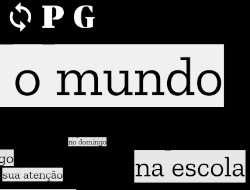 Poemas encontrados (Porto, 2024)
Drawing on texts and poetic procedures by António Aragão, the work reinscribes the aesthetics of collage and found poetry within a dynamic and continuously mutating digital environment. Initially developed as part of the PO.EX CD-ROM project (Porto, 2007), the piece explored generative typography, textual collage, RSS feeds, and algorithmic recombination through Flash, ActionScript, and PHP, and was later recreated in JavaScript. Fed by texts gathered from online newspapers, the textual engine generates variable and unpredictable typographic compositions, transforming the poem into a field of indeterminacy, openness, and continuous metamorphosis, where each reading produces new visual and verbal relations. Poems originally programmed in Flash, ActionScript, and PHP (Porto, 2007), later recreated in JavaScript.
https://telepoesis.net/encontrada
 PoemAds - Sob o signo da devoração (Clermont-Ferrand, 2024)
Generative textual engine and animation built from advertising slogans, exploring the mechanisms of repetition, seduction, and circulation inherent to media language. The corpus brings together slogans from butter, beer, water, automobile, soft drink, banking, credit card, shampoo, and supermarket advertisements, later recombined with lexicons gathered from online advertising slogans. Through algorithmic processes of fragmentation, permutation, and semantic drift, the work transforms promotional rhetoric into an unstable and critical poetic field, where consumption, verbal automatism, and communicational excess are reinscribed as aesthetic experience. The piece employs open fonts and typographic animation as structural elements of its visual and textual composition. Poems originally programmed in Flash/ActionScript (Porto, 2012), recreated in 2024 with poemario.js (Rui Torres and Nuno Ferreira).
https://telepoesis.net/poemads_js
 Poemas no meio do caminho (Porto, 2020)
The work, a sound-based textual engine organized into eight distinct poems, explores poetry as a practice of drift and continuous recombination, transforming the textual journey into a space of negotiation between algorithm and reader intervention. Based on a combinatory matrix, each reading allows users to generate a transient configuration of the poem, giving rise to an unstable and mutable textuality. Variations produced by readers can be published on the Poemário blog, enabling the documentation and sharing of the work’s ephemeral and processual nature.
Authorship and collaborations: Rui Torres (xml, html), Luís Aly (sound) and Nuno M Cardoso (voice). Poems originally programmed in Flash/ActionScript (Porto, 2008), recreated in 2020 with poemario.js (Rui Torres and Nuno Ferreira).
https://telepoesis.net/caminho_js
 brin cadeiras (Porto, 2020)
The work reinscribes the verbal experimentalism of Salette Tavares within a digital environment marked by playfulness, permutation, and syntactic instability. Developed as an animated textual engine, the piece combines poetic fragments and lexicons drawn from Salette Tavares and Fernando Pessoa through continuous recombinatory processes, generating mutable and unexpected verbal configurations. The interaction between voice, text, animation, and algorithmic variation transforms the poem into a performative and experimental space, where playing with language also becomes an exploration of the limits of meaning, sound, and the very materiality of words.
Authorship and collaborations: Rui Torres (xml, html), Américo Rodrigues (voice). Poems originally programmed in Flash/ActionScript (Porto, 2010), recreated in 2020 with poemario.js (Rui Torres and Nuno Ferreira).
https://telepoesis.net/brincadeiras_js
 Amor de Clarice v.2 (Porto, 2020)
Based on the short story «Amor» by Clarice Lispector, this version developed with Poemario.js reinscribes Lispector’s universe within a combinatory and generative textual engine. The work allows readers to choose, replace, and recombine words and poetic fragments, generating textual configurations that are always distinct and unstable. Through algorithmic processes of permutation and semantic drift, the poem becomes an open field of continuous variation, where perception, memory, and estrangement are constantly reconfigured through the interaction between reader and system. Text by Rui Torres based on the short story «Amor» by Clarice Lispector and with her lexicon.
Authorship and collaborations: Rui Torres (xml, html), Carlos Morgado and Luís Aly (sound), Nuno M Cardoso (voice). Poems originally programmed in Flash/ActionScript (Porto, 2008), recreated in 2020 with poemario.js (Rui Torres and Nuno Ferreira).
https://telepoesis.net/amorclarice/v2_js
 Húmus Poema Contínuo (Porto, 2020)
Textual engine with sound built from «Húmus» (1917) by Raul Brandão and «Húmus» (1967) by Herberto Helder. The work brings together the universes of Brandão and Helder through a continuous textual dispositif that recombines verbal matter, voice, sound, and imagetic flow, exploring practices of plagiotropy, rewriting, and textual drift. Between decomposition and regeneration, the poem unfolds as an unstable and mutating organism, making humus simultaneously archive, ruin, and principle of poetic transformation. The recombinations generated by the textual engine extend the tension between memory, death, and metamorphosis present in both works, transforming the text into a processual field of contamination and continuous rebirth.
Authorship and collaborations: Rui Torres (XML, HTML, sound), Luís Aly (sound), Nuno M. Cardoso (voice). Poems originally programmed in Flash/ActionScript (Chapel Hill and Porto, 1999–2008), recreated in 2020 with Poemario.js (Rui Torres and Nuno Ferreira).
https://telepoesis.net/humus_js
 1 corvo nunca mais (Porto, 2020)
Textual engine with sound built from the translation of «The Raven» by Edgar Allan Poe created by Fernando Pessoa. The poem’s 18 sestets are recombined in real time through random procedures applied to a lexicon selected from Pessoa’s works, generating textual and sonic configurations that are always distinct. Voice, sound environments, and textual fragments are continuously reorganized, transforming the poem’s obsessive refrain into a dispositif of variation, echo, and drift. Integrated into the Poemario system, the project also allows readers to save and share their own versions of the poem.
Authorship and collaborations: Rui Torres (XML, HTML), Luís Aly (sound), Nuno M. Cardoso (voice). Poems originally programmed in Flash/ActionScript (Porto, 2009), recreated in 2020 with Poemario.js (Rui Torres and Nuno Ferreira).
https://telepoesis.net/pessoa_js
 Do Peso e da Leveza (Porto, 2020)
Textual engine with sound built from texts and lexicons by Fernando Pessoa and Sophia de Mello Breyner Andresen, exploring tensions between density and transparency, gravity and suspension, matter and fluidity. Through combinatory and generative procedures, textual fragments and sound environments are continuously reorganized, producing poetic configurations that are variable and unstable in each reading. The work transforms the poem into a field of continuous mutation in which the poetic voices of Pessoa and Sophia enter into dialogue, contamination, and recomposition.
Authorship and collaborations: Rui Torres (XML, HTML), Luís Carlos Petry (images), Luís Aly (sound). Poems originally programmed in Flash/ActionScript (Porto, 2009), recreated in 2020 with Poemario.js (Rui Torres and Nuno Ferreira).
https://telepoesis.net/dopesoedaleveza_js
 Cantiga (Porto, 2020)
«Cantiga» (Porto/Lisboa, 2012). Textual engine built from the poem «Cantiga» by Salette Tavares, in dialogue with the lexicon of medieval Galician-Portuguese cantigas. The work reinscribes the playful, musical, and permutational dimension of Salette Tavares’s poetry within a combinatory dispositif where repetition, variation, and textual drift generate ever-changing poetic configurations. Fed by vocabulary drawn from medieval cantigas and structured through algorithmic procedures, the poem explores tensions between oral tradition, verbal experimentalism, and digital textuality, transforming reading into a field of continuous recombination.
Authorship and collaborations: Rui Torres (XML, HTML). Poems originally programmed in Flash/ActionScript (Porto/Lisboa, 2012), recreated in 2020 with Poemario.js (Rui Torres and Nuno Ferreira).
https://telepoesis.net/cantiga_js
 fakephone4a(n)droid (Porto and Barcelona, 2019)
The work intersects physical object, mobile interface, and generative textuality, expanding poetry into a hybrid territory between communication device, sound performance, and manipulable archive. Conceived as a mixed-media object, fakephone4a(n)droid combines Java code for Android printed on transparent acetate, typographic poem cards, and a web app, enabling textual overlays, concealments, and recombinations. The fragmentation of poems into functions, calls, and dichotomies reinforces a poetics of interference, listening, and discontinuous circulation of language, while critically reflecting on mobile devices, technological mediation, and the materiality of code.
Authorship and collaborations: Rui Torres (xml, html), Luís Aly (sound), Nuno M Cardoso (voice), text-to-speech (voices). App web created with poemario.js (Rui Torres and Nuno Ferreira).
Installations/Exhibitions/Publications > July 2025: VIGO volume 2 – Portuguese Visual Poetry, Org. Fernando Aguiar, ed. HOTEL DADA || 23 February 2019: acciones sonhoras #13, L’Automàtica, Barcelona, Spain || 7-12 May 2019: nit sonhoras - exhibition & poetry event, Arts Santa Monica, Barcelona, Spain.
https://telepoesis.net/fakephone [web app]
https://www.sonhoras.org/producte/fakephone/ [typographic cards]
 Lost in Translation (Porto, Lancaster and Barcelona, 2019)
Adventures in automatic translation and text-to-speech. Exploring the deviations produced by machine translation and synthetic voices, the work transforms error, semantic drift, and linguistic instability into poetic material. Each passage between languages brings forth new layers of estrangement, bringing translation closer to textual reinvention.
Authorship and collaborations: Rui Torres (xml, html), Luís Aly (sound), text-to-speech (voices). Created with poemario.js (Rui Torres and Nuno Ferreira).
https://telepoesis.net/curso-breve/
 Árvore (Porto, 2018)
The work is structured as a generative system built around botanical references and fragments of modern Portuguese poetry, bringing together processes of vegetal growth and textual recombination. The variations produced by the combinatory engine give rise to a verbal ecology in continuous transformation, where species, verses, and images mutually contaminate one another. Inspired in poems by António Gedeão, António Ramos Rosa, Fernando Pessoa, Herberto Helder, Miguel Torga and Ruy Belo. Lexicon based on the flora of Northern Portugal. Rui Torres (xml, html), Luís Aly (sound). Created with poemario.js (Rui Torres and Nuno Ferreira).
Installations/Exhibitions > May 2019: Villa Moraes, Ponte de Lima || June 2019: headquarters of the InterMunicipal Community of Alto Minho, Viana do Castelo || 17 May 2023: Digital humanities and sustainability, in: "Roots of Humanities, under the sign of sustainability", Festival SER HUMANO - Festival das Humanidades, org. CODA / UP, FLUP I&D and Botanical Garden of the University of Porto, Biodiversity Gallery.
 Cushioned Fakescripts (Porto and Kassel, 2017)
Poetic and typographic object composed of printed code fragments drawn from diverse programming languages, appropriated, displaced, and adapted for the inscription of poetry. The work transforms computational syntax into a visual and material field of tension between legibility and opacity, functionality and poetic deviation. Between code and object, the fakescripts critically explore the materiality of digital languages and the invisible systems that structure contemporary communication, proposing a tactile, fragmentary, and performative reading of the program-text. Rui Torres (text-code). Friedrich W. Block (translation).
Installations/Exhibitions/Publications > July 2025: VIGO volume 2 – Portuguese Visual Poetry, Org. Fernando Aguiar, ed. HOTEL DADA || 30 August - 6 October 2019: POESIS – Sprachkunst | Language Art, Curated by Friedrich W. Block, Kunsttempel Kassel, Germany || 14 September - 15 October 2017: p0es1s – postdigital, Language art, Curated by Friedrich W. Block, Kunsttempel, Kassel, Germany.
http://p-dpa.net/work/fakescripts
 a separação:: a(n)estesia (Berkeley and Porto, 2016)
The work develops a combinatory textual and sonic engine built from the appropriation and recombination of political propaganda speeches, soundbites, advertising slogans, commercials, jingles, and diverse media fragments. Structured as a textual constellation in permanent mutation, the piece articulates random procedures of verbal and sonic recombination that generate unstable relations between political language, advertising, media memory, and social critique. The texts are distributed in two colors — green and red — visually evoking the Portuguese flag: green aggregates fragments of propaganda, slogans, and media discourse, while red presents poems and critical fragments written by Rui Torres. Gradually, the page becomes occupied by successive layers of text and sound until reaching a state of visual and acoustic saturation, after which the poem restarts within a new combinatory cycle. Through superimposition, repetition, and semantic compression, the work explores the sonic materiality of propaganda and the fragmentation of the Portuguese media sphere, transforming the poem into a field of tension between anesthesia, information overload, and critical awareness.
Authorship and collaborations: Rui Torres (XML, HTML, sound collection and editing). Created with Poemario.js (Rui Torres and Nuno Ferreira).
Installations/Exhibitions >22 November 2023 - 21 January 2024: Portuguese Experimental Poetry, Gallery Mezanino, CAIXA Cultural Curitiba, Brazil || 21-22 April 2020: World Creativity Day 2020 || 21 April 2019: World Creativity Day 2019, ZERO Box Lodge, Porto. || 17 October - 16 December 2018: Portuguese Experimental Poetry, CAIXA Cultural Brasília, Brazil.
https://telepoesis.net/aseparacao
 «Estou Vivo e Escrevo Sol» (Berkeley, Bremen, Barcelona and Porto, 2016)
The work develops a textual constellation around the poetic universe of António Ramos Rosa through combinatory and generative processes. The project functions as a real-time poetry generator visualized as constellations, exploring the verbal richness of António Ramos Rosa through the Poemario.js library, developed to combine text and sound. The continuous recombination of fragments produces a verbal field in permanent expansion, where writing and breath seem to merge, giving rise to multiple poetic and interpretative configurations. Enriched by sound compositions and voices, the work proposes a dynamic and mutable poetic experience centered on ephemerality, listening, and the continuous renewal of language. Through António Ramos Rosa: with words bodies silences and shadows.
Authorship and collaborations: Rui Torres (xml, html), Luís Aly (sound), Nuno M Cardoso (voice). Created with poemario.js (Rui Torres and Nuno Ferreira).
Installations/Exhibitions > 07 September - 02 November 2024: Net Arte no Triângulo das Bermudas: Contributos para uma reflexão sobre arte e internet em Portugal, CAAA Centro para os Assuntos da Arte e Arquitectura, Guimarães, Curated by Sofia Ponte and Maria Luís Neiva.
https://telepoesis.net/estou-vivo-e-escrevo-sol
 Fantasia breve, a palavra-espuma (Porto, 2016)
The work explores the anagram as a procedure of textual metamorphosis inspired by the experimental writing of Ana Hatherly. Organized into nine texts in metamorphosis (fantasia breve) and nine poems in indeterminacy (palavra-espuma), it develops processes of recombination, permutation, and verbal instability that generate multiple poetic configurations from the same set of fragments and lexicon. Through syntactic displacements, typographic fragmentation, and the continuous mutation of words, the poems transform before the reader as unstable surfaces of language, extending into the digital environment the visual, playful, and combinatory dimensions characteristic of Hatherly’s work.
Authorship and collaborations: Rui Torres (XML, HTML), Nuno Ferreira (JavaScript). Created with an adapted version of Poemario.js (Rui Torres and Nuno Ferreira).
Installations/Exhibitions > 30 June - 5 July 2016: Festival Silêncio, ReAnagramas, Lisbon, Curated by Fernando Aguiar.
https://www.telepoesis.net/palavra-espuma
 // A fakescript for your faked life (Porto and Berkeley, 2016)
Textual and visual work constructed through the appropriation and poetic reinscription of programming languages such as Basic, Java, C, and Perl. Developed for Media Instáveis, the piece presents itself as a false functional script in which commands, syntaxes, and algorithmic structures are displaced into a hybrid territory between code, poetry, and semantic noise. Through the simulation of executable instructions and the fragmentation of computational language, the work questions the regimes of automation and technological mediation that permeate contemporary life, transforming code into a space of critical fiction and verbal experimentation.
Authorship and collaborations: Rui Torres (concept and textual programming). Nuno Ferreira (textual programming).
Installations/Exhibitions > 17 April - 21 May 2016: FAZ TU MESMX - ARTE POR INSTRUÇÃO, Curated by UNSTABLE MEDIA (Ana Carvalho, Margarida Carvalho, Sofia Ponte and paula roush), Sputenik the Window, Porto, Portugal.
https://telepoesis.net/fakescript.html
 Fakescripts para Ponte de Lima (Porto and Ponte de Lima, 2016)
Developed within the context of the Lethes Art festival, the work reinscribes the logic of fakescripts into an urban and everyday environment, transforming public garden benches into surfaces of poetic inscription and visual interference. Colored poems printed on transparent adhesive paper overlay fragments of code, false instructions, and hybrid textualities onto public furniture, inviting readings oscillating between transparency, concealment, and semantic deviation. Appropriating the aesthetics of computer code and procedural language, the work critically explores the communication and programming devices that structure contemporary daily life, converting them into poetic and performative matter.
Authorship and collaborations: Rui Torres (concept and textual programming). Nuno Ferreira (textual programming).
Installations/Exhibitions > 1 July - 31 August 2016: Re-Cognition, Curated by Isabel Patim, ART-MAP, Ponte de Lima, Portugal.
https://telepoesis.net/fakescripts
 Gerador de Homeóstatos (Porto, 2015)
Inspired by the Homeóstatos of José-Alberto Marques, the work develops a generative textual engine that reinscribes the visual and combinatory matrix of the original poems within a digital system of continuous variation. Created in the context of the «Homenagem aos Homeóstatos de José-Alberto Marques» by the PO.EX Digital Archive, the project employs a selected lexicon and an adapted version of Poemario.js to generate textual configurations in permanent mutation, exploring balance, repetition, permutation, and instability as structuring principles of poetic composition. The dynamic spatialization of words and the constant reorganization of fragments extend the processual and experimental dimension of the Homeóstatos into a digital environment, transforming the poem into a field of tensions between order and deviation, system and indeterminacy.
Authorship and collaborations: Concept, XML, and HTML: Rui Torres. JavaScript: Nuno Ferreira.
https://www.telepoesis.net/homeostatos
 Poemas no meio do caminho (Porto, 2008)
The work is an immersive three-dimensional poetic environment composed of eight interconnected panoramic spaces, each combining generative textual and sonic elements. Readers navigate through virtual landscapes where combinatory poems, algorithmically recombined soundscapes, and ghostly video portals create shifting atmospheres and transitional passages between environments. Distributed throughout the space, these spectral video gateways function as poetic thresholds, transforming reading into an embodied experience of exploration, immersion, and continuous variation.
Resources used: Flash/Actionscript. Collaborations: Nuno F. Ferreira (programming), Luís Aly (sound), Nuno M Cardoso (voice), Luís Carlos Petry (images). 4t Premi Internacional "Ciutat de Vinaròs" de Literatura Digital.
Installations/Exhibitions > 1-9 September 2018: Máquinas de Escritura, Galería Libertad, Querétaro, Hay Festival / Centro de Cultura Digital, Mexico || 11 March - 2 September 2016: No Legacy || Literatura Eletrónica, Relocating Literature in Media, Blending Languages, Unearthing Literary Archeologies, Bernice Layne Brown Gallery, University of California, Berkeley, Doe Library, Curated by Alex Saum-Pascual and Élika Ortega || 23-26 April 2016: Anthropoetry: Modern Expression of the Human Condition, National Poetry Month, Vancouver Community Library, Vancouver, WA || 1-31 August 2015: p2p: Polish-Portuguese E-Lit, ELO 2015 exhibition Decentering: Global Electronic Literature, 3,14 gallery in Bergen, Norway, Curated by Álvaro Seiça and Piotr Marecki || 14-15 May 2015: Language and the Interface, in: International Conference 'Digital Literary Studies', University of Coimbra, Curated by Daniela Côrtes Maduro, Ana Marques da Silva and Diogo Marques || 2-20 November 2013: Repurposing in Electronic Literature, DIGGallery, Košice, Slovakia, Curated by María Mencía e Zuzana Husárová, Art directing by Richard Kitta & DIG || 1 July - 30 September 2009: XV Bienal Internacional de Arte de Cerveira, Vila Nova de Cerveira, Portugal.
https://telepoesis.net/caminho/index_js.html
(Flash version restored with ruffle.js)
https://telepoesis.net/caminho
(URL of the original, obsolete Flash version)
https://conifer.rhizome.org/elo/
(Flash version restored by the Electronic Literature Lab with Conifer)
https://po-ex.net/
(Images and sounds)
https://collection.eliterature.org/2/
(Electronic Literature Collection, Volume 2)
 Amor de Clarice (Chapel Hill and Porto, 1999-2005)
Drawing on the short story «Amor» by Clarice Lispector, the work transforms the introspective intensity and estrangement characteristic of Lispector’s universe into an interactive multimedia poetic experience. Organized into 52 poetic fragments, the piece combines text animation, spatial displacement of words, voice, video, and sound composition, allowing readers to continuously reconfigure their reading paths. Twenty-six fragments articulate visual textual backgrounds with sound compositions by Carlos Morgado; the remaining pieces combine experimental videographic fragments by Ana Carvalho with sound environments by Luís Aly. In both series, the voice of Nuno M. Cardoso introduces a performative and embodied dimension to reading, reinforcing the atmosphere of suspension, drift, and unease that permeates the work. Text by Rui Torres based on «Amor» by Clarice Lispector. Computer-animated, interactive poetry with sound and video.
Authorship and collaborations: Rui Torres (Flash/AS), Carlos Morgado (music), Luis Aly (sound), Ana Carvalho (video), Nuno M Cardoso (voice).
Installations/Exhibitions > 3-5 November 2016: Shapeshifting Texts - An exhibition about electronic and experimental literature, University of Bremen, Germany, Curated by Daniela Côrtes Maduro || 23-26 April 2016: Anthropoetry: Modern Expression of the Human Condition, National Poetry Month, Vancouver Community Library, Vancouver, WA, USA || 28 January – 10 April 2016: La paraula pixelada. La literatura a l’era digital, Arts Santa Mònica, Barcelona, Spain || 1-31 August 2015: p2p: Polish-Portuguese E-Lit, ELO 2015 exhibition Decentering: Global Electronic Literature, 3,14 gallery Bergen, Norway, Curated by Álvaro Seiça and Piotr Marecki.
https://telepoesis.net/amorclarice/index_js.html
(Flash version restored with ruffle.js)
https://po-ex.net/
(Galleries of screencaptures and sounds)
https://telepoesis.net/amor/
(Images and Sound - version 2)
https://conifer.rhizome.org/elo/
(Flash version restored by the Electronic Literature Lab with Conifer)
http://collection.eliterature.org/
(Electronic Literature Collection, Volume 2)
https://telepoesis.net/amorclarice
(URL of the original, obsolete Flash version)
 Amor-mundo ou a vida esse sonho triste (Sao Paulo, Beijing and Porto, 2006)
This work develops a set of generative poems and textual fragments inspired by the lyrical universe of Florbela Espanca, exploring visual and sonic animation regimes based on recombination and typographic spatialization. Drawing on remixed sonnets by Florbela Espanca, the work is organized into five poems — «Let Me Be Your Saddest Sorrow», «I Wanted to Be the High Sea», «I Wander Through the World Reading the Mysterious Book», «I Am the Wind That Moans and Wants to Enter», and «Dead Hours» — which readers can activate and manipulate interactively. Verbal and sonic fragments are randomly distributed across the screen, creating mutable textual constellations in which words, voices, colors, and forms emerge through continuous reorganization. Each interaction generates new readings, connections, and poetic configurations, transforming reading into a performative process of exploration and recomposition of Florbela’s imaginary universe. Includes a Mandarin version commissioned by 0 1 Digital Poetry, Beijing, China.
Authorship and collaborations: Rui Torres (text, Flash, AS, HTML), Jared Tarbel (programming), Filipe Valpereiro and Nuno F. Ferreira (sound programming), Sérgio Bairon and Luís Aly (sound), Nuno M. Cardoso (voice), Qiu Keman (translation, voice).
Installations/Exhibitions > 8 December 2006: Cyberpoetry exhibition, Festa da Poesia 2006, Biblioteca Municipal Florbela Espanca, Matosinhos, Portugal.
https://telepoesis.net/amor-mundo (URL of the original, obsolete Flash version)
https://po-ex.net/
(Images and Videos)
http://www.revistainteract.pt/
(In: Revista Interact, obsolete)
https://telepoesis.net/amor-mundo/index_js.html
(Portuguese; Flash version restored with ruffle.js)
 Mar de Sophia (São Paulo and Porto, 2005)
Through processes of textual fragmentation, recombination, and drift, the work reinscribes the poetic universe of Sophia de Mello Breyner Andresen within a digital environment shaped by continuous mutation and interactivity. Based on a mapped lexicon structured through databases — to which vocabularies from other authors, such as Lewis Carroll, may also be added — text, sound, and animation are articulated generatively, producing distinct poetic and sonic variations with each reading. Between contemplation and instability, the work transforms the act of reading into a performative process of exploration, reconfiguration, and continuous reinterpretation of language. Resources Used: Flash, Actionscript, XML, PHP, python. Collaborators: Nuno F. Ferreira (programming), Filipe Valpereiro (sound programming), Sérgio Bairon, Luís Aly (sound), Nuno M Cardoso (voice). Texts by Sophia Andresen & Lewis Carroll.
https://telepoesis.net/mardesophia
(URL of the original, obsolete Flash version)
https://telepoesis.net/mardesophia/index_js.html
(Flash version restored with ruffle.js)
 Tema procura-se (Porto, 2004)
Programmed text, with sound. First work exploring the combinatorial technique in digital media, integrating it into animated multimedia poetry.
Resources Used: Flash, Actionscript, XML. Collaborators: Nuno M Cardoso (voice).
https://telepoesis.net/tema
(URL of the original, obsolete Flash version)
https://telepoesis.net/tema/index_js.html
(Flash version restored with ruffle.js)
 o exacerbar da solidão ou mil formas de (tentar) preencher um vazio (Porto, 2022)
Artistic project with computer generated text.
Authorship and collaborations: Sónia Granja Barbosa (Selection of texts and lexicon), Rui Torres (xml). Created with poemario.js (Rui Torres and Nuno Ferreira).
Staging > 18-20 March 2022: NAPALM (Companhia de Teatro Dança em Conjunto ou Alternadamente), Artistic Direction by Jaime C. Soares, Teatro Helena Sá e Costa, Porto.
https://telepoesis.net/o-exacerbar-da-solidao
 Tópicos cartesianos atípicos (Porto, 2020)
Generative textual philosophy from four fundamental propositions of René Descartes.
Authorship and collaborations: Paulo Alexandre e Castro (selection of propositions and creation of the lexicon), Rui Torres (xml, html). Created with poemario.js (Rui Torres and Nuno Ferreira).
Installation/Exhibition > 27 November 2020: ARTeFACTo, Artech International Conference, University of Algarve, Faro, Portugal, org. CIAC - Research Centre in Arts and Communication.
https://telepoesis.net/cartesianismos/
 Oralengas (Porto and Coimbra, 2018-2020)
A set of three interactive digital works developed from mural paintings by Costa Pinheiro, combining visual animation, Portuguese oral folk literature, and generative textuality for different age groups. Integrated into the collaborative project Murais e Literatura, the work explores the digital remediation of pictorial narrative through three reading levels: a digital picture-book aimed at children aged 4 and above; a generative poem built from the corpus of Portuguese oral children’s literature for readers aged 6 and above; and a non-linear interactive narrative intended for older readers. Combining playfulness, narrative experimentation, and digital literacy, the work transforms the digital space into an environment of aesthetic exploration, textual recombination, and active reader participation.
Authorship and collaborations: Texts programmed with Poemario.js (Rui Torres and Nuno Ferreira). Murais e Literatura project team: Ana Maria Machado, Ana Albuquerque e Aguilar, Júlia Andrade, Luís Lucas Pereira, Rui Torres, and Thales Estefani.
https://telepoesis.net/costapinheiro
 Abílio-José Santos: «era uma vez uma gata» and «interrogações» (Porto and Maia, 2019)
Reinterpretations of works by Abílio-José Santos.
Authorship and collaborations: Rui Torres (xml, html), Bruno Ministro and Diogo Marques (xml), Anabela Garcia (voice). Created with poemario.js (Rui Torres and Nuno Ferreira).
Installations/Exhibitions > 4 July - 8 September 2019: re:A-JS (deve ler-se reage-se), curated by Rui Torres, Diogo Marques and Bruno Ministro, part of: Abílio-José Santos. Revelação: Concretos e Visuais, Fórum da Maia / Centr’Arte, Maia, Portugal.
https://telepoesis.net/abilio/
 e-lit jazz (Porto and Victoria, 2016)
The work re-situates electronic literature through the aesthetics, structures, and improvisational logic of jazz, while simultaneously riffing on e-lit itself by approaching digital textuality as performative, unstable, and collaborative composition. Conceived as a theoretical performance unfolding across multiple forms, the piece combines a seventeen-paragraph essay on electronic literature with generative recombination, improvisation, sound, and performative textual interaction. Developed with Poemario.js, the work explores rhythm, variation, interruption, and recursive citation as poetic and critical strategies, transforming theoretical discourse into an open field of live textual improvisation.
Authorship and collaborations: Rui Torres (XML, HTML), Sandy Baldwin (text, performance), Nuno Ferreira (wheel_of_fortunAly), Luís Aly (sound). Created with Poemario.js (Rui Torres and Nuno Ferreira).
https://telepoesis.net/elitjazz
 O fim do princípio de... (Porto, 2016)
In response to an invitation from Pedro Eiras, org. Seminários do Fim do Mundo (Série IV, 2016, FLUP). Interrogations, provocations... the ends as metamorphosis; the programmed and multiple text as door (solstice), passage, new beginning. The end of the beginning of the end of...
Authorship and collaborations: Rui Torres (xml, html). Created with poemario.js (Rui Torres and Nuno Ferreira).
https://telepoesis.net/fimdomundo
 Oceanografias (a memória da água) (Berkeley, 2016)
Reinterpretation of «Oceanografias (a memória da água)» by Antero de Alda, originally programmed on a microcomputer Sinclair ZX Spectrum (Sever do Vouga, 1/1/1986).
Authorship and collaborations: Rui Torres (xml, html). Created with poemario.js (Rui Torres and Nuno Ferreira).
 Cyberliterature (1977-1993) (Porto, 2015)
Poems originally programmed by Pedro Barbosa in 1976 using text generation programs «Permuta» and «Texal» in Fortran, Algol, Neat, Basic and BCPL.
Authorship and collaborations: Rui Torres (xml), Carlos Amaral (js, html, css, translation). Created with an adapted version of poemario.js (Rui Torres and Nuno Ferreira).
https://collection.eliterature.org/3/
 Álea e Vazio (Porto, 2014)
Texts by E. M. de Melo e Castro originally published in «Álea e Vazio» (1971).
Authorship and collaborations: Rui Torres (xml, html). Created with poemario.js (Rui Torres and Nuno Ferreira).
 Poeta Artificial (Porto, 2014)
Parody with the news broadcast by UC and Lusa on 20/03/2014: "PoeTryMe: researcher from the U. Coimbra creates the first Portuguese «artificial poet». Hugo Oliveira, researcher from the University of Coimbra, created PoeTryMe, a computer system that generates poems in less than a minute"...
Authorship and collaborations: Rui Torres (xml, html). Created with poemario.js (Rui Torres and Nuno Ferreira).
https://telepoesis.net/poeta_artificial
 Untitled (for Ana Mendieta) (Chapel Hill, 1998)
First experiences with animation, interactivity. The ephemeral in Ana Mendieta's art serving as the basis for the first hypermedia questioning about the unarchiveable, or the archive of nothingness, that of silence.
https://telepoesis.net/untitled
(URL of the original, obsolete Flash version)
https://telepoesis.net/untitled/index_js.html
(Flash version restored with ruffle.js)